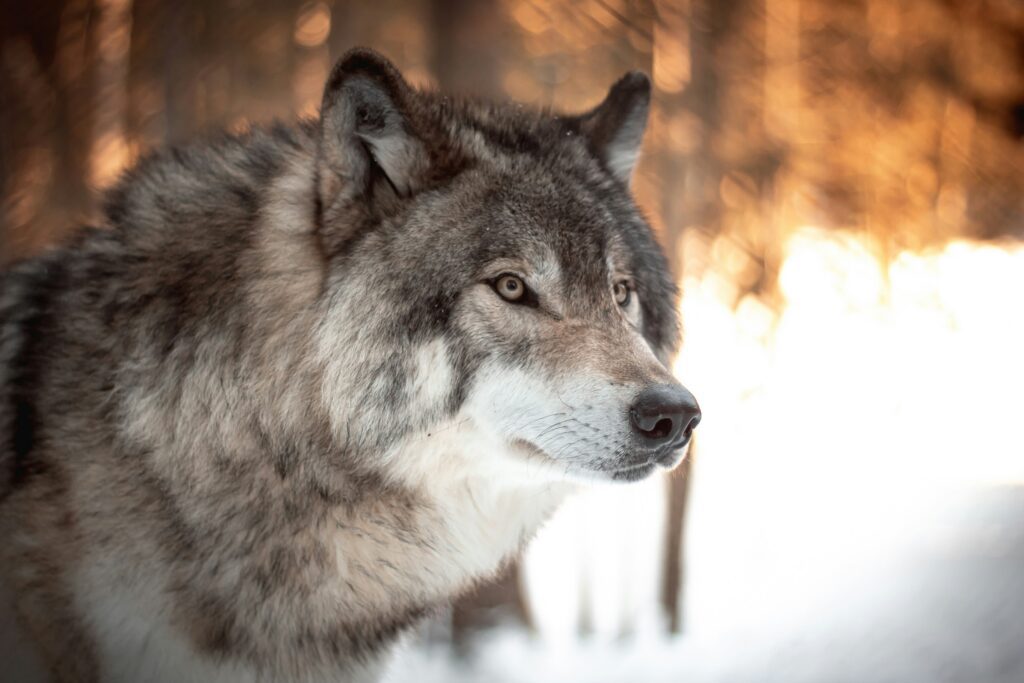
For thousands of years gray wolves roamed across the temperate and polar regions of North America. However, by the early 1900s, they had all but disappeared in the continental United States. Now wolves are once again thriving in Yellowstone National Park. This is their story--the chronicles of Yellowstone wolves.
Gray wolves have existed for hundreds of thousands of years, living across the world in the Northern Hemisphere. As technological advances starting around the 16th century allowed human populations to grow in Europe, Asia, and eventually North America, humans came in frequent contact with wolves and had means to kill many quickly. Wolves were quickly eradicated completely in places like Great Britain and Japan.
It wasn’t until the mid-20th century when thinking in terms of conservation became mainstream—for much of human existence our thought process was simply about survival—hunting, gathering, farming, or eventually working long hours in factories, mines, etc. When it became easy to remove threats to your survival, such as wolves were to human food sources like livestock—well, it can happen quickly—before we have a chance to consider broader implications.
When wolves began running out of wild game to hunt (also affected by humans), wolves hunted livestock more often. This was the biggest factor in conflicts between humans and wolves in the US. A hunter killed the last wolf in Yellowstone in 1926, and by the mid-1900s a small population in Minnesota and Michigan were the last wolves remaining in the continental US. Hunting wolves in the US was, at times, government-sponsored—you could be paid to kill wolves.
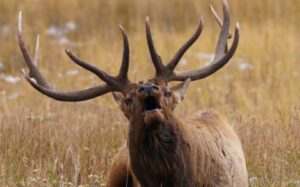
Over time large herbivore populations grew in Yellowstone because wolves weren’t there to keep them in check—each species matters in an ecosystem. This was especially true of elk. Too few wolves might mean too many elk which in turn eat too much vegetation, which in turn destabilizes rivers and streams, which in turn affects beavers and fish… well, you get the point.
When humans first started gaining time and energy to think about things outside their immediate circle, they saw the earth not simply as a resource to survive but saw it for its beauty and diversity—a resource to help humans thrive. However, this thinking doesn’t eliminate the fact that wolves, when reintroduced, still are a threat to livestock. (Not entirely different than the issue of bison reintroduction, for while they certainly improve ecosystems and all current populations of American bison combined are less than 1% of their original population, many believe they have diseases that are a threat to livestock. But that’s a story for another day.)
Gray wolves from Alberta and British Columbia, Canada, were reintroduced to Yellowstone in 1995 (and continue to be reintroduced at other carefully selected locations across the Western US). From the 31 reintroduced wolves, there are now more than 500 across the Greater Yellowstone Ecosystem. Some of the wolves reintroduced to Idaho naturally migrated to Washington, Oregon, and California. If species are given the opportunity with appropriate needs met, they will naturally refill their niche.
The reintroduction was not popular with everyone, including some ranchers, for whom their livelihood depends on their livestock. Additionally, although the reintroduced wolves are technically the same species as the originals, being from areas of Canada with more and larger prey for the wolves meant that these new wolves in Yellowstone are slightly larger. Fortunately, it doesn’t appear that the Yellowstone wolves have any unforeseen consequences due to their size.
Elk populations are back to normal levels within Yellowstone, and many believe other aspects of the Yellowstone ecosystem are healthier as well because of wolves. The balance between people and wolves continues to prove tricky, though. The question of how many wolves are enough wolves receives many different answers, and as long as livelihoods are affected, there will always be conversations over the value of wild animals. Permitted hunting of wolves is allowed in some states.
American wolves have had a hard road the last few centuries, including red wolves, native to the Southeast US, that are still critically endangered. Yellowstone though, is a great success story for many species and that includes wolves. Many individuals and packs are followed publicly and researched intently. Lamar Valley is one of the best places to see wolves in Yellowstone National Park.
Growing up, Dillon’s family took him to nearby national parks so often that he took the parks for granted. In his childhood, he had the privilege of watching Yellowstone wolf pups play through the lens of a conservationist’s roadside telescope.
Photo by Milo Weiler on Unsplash