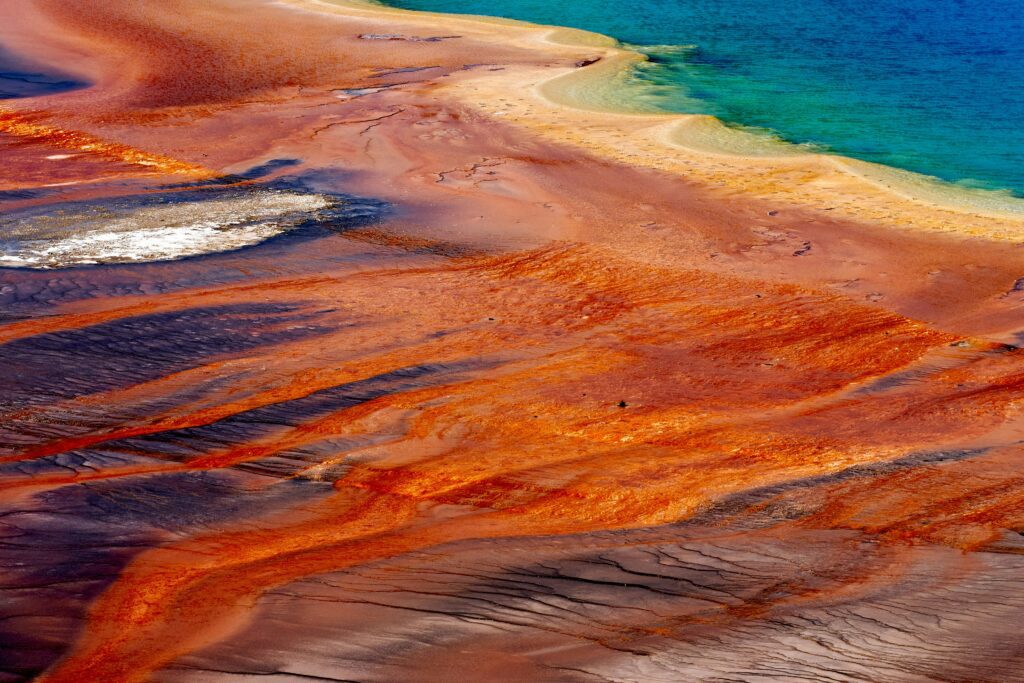
Yellowstone National Park’s hot springs are absolutely mesmerizing. Yellowstone hot springs can be so colorful, with an incredible diversity and vibrancy—but why are they so unique in this? To understand this better, let’s talk about the two general types of hot springs in Yellowstone: acidic and neutral/alkaline (basic pH).
Acidic Hot Springs
Acidic hot springs (pH ranging 1 to 3) feature both temperatures too hot and acidity too extreme for animals to survive. These tend to be less colorful yet still neat in their own way, being often milky or muddy looking. This results from the pool's acidity dissolving adjacent minerals. Acidic springs have hydrogen sulfide, which reacts at the surface with oxygen to form sulfuric acid.
Amazingly, life does still exist in these springs in the form of (our new favorite term) acidophilic thermophiles (let us know if you find opportunities to use this in everyday conversation this week), which simply means 'acid-loving, heat-loving.' Very aptly named, indeed. Examples of acidic hot springs in YNP include Sulphur Caldron and Norris Acid Pools.
Neutral/Alkaline Hot Springs
Neutral/alkaline hot springs (pH ranging 7 to 9) often have hotter surface temperatures, so they are no less dangerous. However, due to the complex chemical makeup of some of YNP’s springs and different gases, such as carbon dioxide causing less acidity, these are able to sustain more life.
Extremophiles (another fun word referring to microbes that can survive in extreme conditions) take their places in turn, often in rings, related to the temperature that best sustains them. These can be red, orange, yellow, or green. Often forming the outermost ring is sinter, which is grayish-whitish precipitated silica (this is dissolved in more acidic pools). Near the center is the hottest, meaning less life is able to survive (I guess even thermophiles have their limits). In this open water, blue light scatters the most in a similar effect to why the sky or eyes can be blue. Examples of these pools include Grand Prismatic Spring and the water that comes out of the iconic Old Faithful.
Geologist Walter Harvey Weed summed it up eloquently almost a century and a half ago:
“The vegetation of the acid waters is seldom a conspicuous feature of the springs. But in the alkaline waters… the red and yellow tinges of the algae combine with the weird whiteness of the sinter and the varied blue and green of the hot water to form a scene that is, without doubt, one of the most beautiful as well as one of the strangest sights in the world.”
Growing up, Dillon could see the Grand Teton from his house on a clear day. His family took him to nearby national parks so often that he took the parks for granted. It took the rigors of life to teach him how good he had it, and he now spends as much time in the mountains as possible.
Photo by Doctor Tinieblas on Unsplash